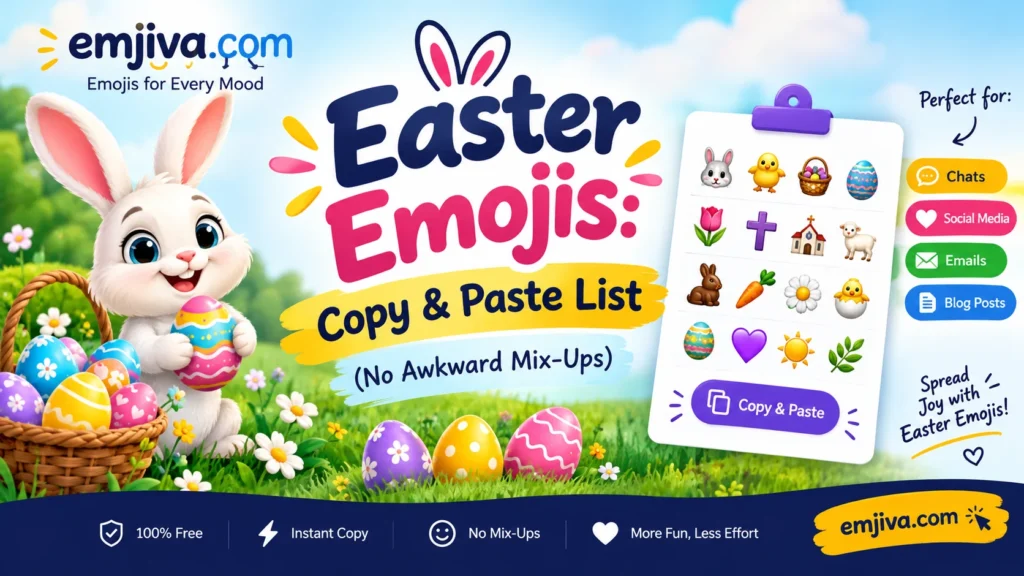
Start with the awkward fact: there is no official Easter emoji. Dictionary.com points out that people just borrow symbols linked to the holiday, and none of them is the designated one.
So the real question isn’t “which one is correct?” It’s “which one will my reader understand as Easter, and feel comfortable receiving?” The sets below are ready to copy, and the sections after them cover the parts most lists skip: which emojis can’t say “Easter” without help, how to choose for a mixed audience, and what a screen reader does with a long string of eggs.
Copy-and-Paste Easter Emojis by Situation
| Situation | Copy this |
|---|---|
| General “Happy Easter” | 🐣🐰🥚 |
| Egg hunt | 🧺🥚🐰 |
| Chocolate and candy | 🍫🐰🧺 |
| Family brunch | 🥚🌷🍳 |
| Spring card or gift | 💐🌷🐣 |
| Religious blessing | ✝️🙏 |
| Church service invite | ⛪✝️🙌 |
| Sunrise service | 🌅⛪✝️ |
Three emojis is a good ceiling. The reason comes up near the end.
The Full Easter Emoji List
Chicks, Bunnies, and Eggs
| Emoji | Name | What it usually says |
|---|---|---|
| 🐣 | Hatching Chick | New life and spring; the best all-round Easter pick |
| 🐤 | Baby Chick | Cute, light spring posts |
| 🐥 | Front-Facing Baby Chick | Same mood as 🐤 from the front |
| 🐰 | Rabbit Face | The Easter Bunny |
| 🐇 | Rabbit | The animal itself, often hopping |
| 🥚 | Egg | Egg hunts, dyeing, cooking |
| 🪺 | Nest with Eggs | New beginnings and spring |
Baskets, Candy, and Treats
| Emoji | Name | What it usually says |
|---|---|---|
| 🧺 | Basket | Easter baskets (see the next section) |
| 🍫 | Chocolate Bar | Easter chocolate |
| 🍬 | Candy | Sweets in the basket |
| 🎁 | Wrapped Gift | Surprises from the Easter Bunny |
| 🥕 | Carrot | A playful nod to the bunny |
Spring Flowers and Fresh-Start Symbols
| Emoji | Name | What it usually says |
|---|---|---|
| 🌷 | Tulip | Spring and decorations |
| 💐 | Bouquet | Gifts and cards |
| 🌱 | Seedling | Renewal |
| 🌅 | Sunrise | Sunrise services and fresh starts |
Faith and Church Emojis
| Emoji | Name | What it usually says |
|---|---|---|
| ✝️ | Latin Cross | The Christian meaning of Easter |
| ☦️ | Orthodox Cross | Orthodox Christian greetings |
| ⛪ | Church | Services and gatherings |
| 🙏 | Folded Hands | Prayer and thanks |
| 🙌 | Raising Hands | Joy and praise |
| 🕯️ | Candle | Vigil and light |
Which Easter Emojis Say “Easter” on Their Own?
Here’s something most lists never mention: several “Easter emojis” only mean Easter because of the season or the words around them. On their own they can point somewhere else.
| Emoji | Does it say “Easter” alone? | Why |
|---|---|---|
| 🐣 | Mostly, in spring | Emojipedia says it can also mean chicken as food or the slang sense of “chick” |
| 🐰 | Usually | It’s a rabbit; spring and context turn it into the Easter Bunny |
| 🥚 | Not reliably | Emojipedia notes it’s common at Easter but also links it to cooking |
| 🧺 | Rarely | Emojipedia says it’s commonly used for laundry or a picnic |
| 🌷 | Spring, not Easter specifically | Works for any spring message |
| ✝️ | Christian faith broadly | The word “Easter” in the message does the rest |
The practical lesson: pair the weak ones with a strong one. 🧺 on its own might look like laundry day, but 🧺🥚 reads as an egg hunt. 🥚 next to 🐰 reads as Easter, while 🥚 next to 🍳 reads as breakfast. And when it matters (a flyer, a work announcement, a customer text), put the word “Easter” in the message and let the emoji decorate it.
Which Easter Emoji Fits Your Audience?
Easter is a religious holiday for some people, a chocolate-and-egg-hunt day for others, and a long weekend for the rest. Pick the audience first and the emoji second.
| Your audience | Safest choices | Think twice about |
|---|---|---|
| Close friends | Almost anything | Nothing in particular |
| Church or faith group | ✝️ ⛪ 🙏 🙌 ☦️ | Heavy candy and bunny strings, depending on the community |
| Kids and family | 🐰 🥚 🧺 🍫 🐣 | A row of crosses can feel heavy in a kids’ message |
| Work or mixed audience | 🐣 🌷 🌱 💐 | Religious symbols, unless you know the group |
| Brand or public account | 🐣 🥚 🌷 | Anything that reads as a statement either way |
A few quick judgment calls:
- Religious greeting: use ✝️, ⛪, 🙏, or 🙌 and add words. A lone cross can read as decoration, but “He is risen 🙌” or “Blessed Easter ✝️” leaves no doubt.
- Family and kids: 🐰, 🥚, 🧺, and 🍫 point to egg hunts and baskets. They read as fun and traditional, not devotional.
- Work or mixed audience: 🐣, 🌷, and 🌱 are the low-risk choices. They suggest spring and fresh starts without taking a side.
- Mixing bunnies and crosses: plenty of people do it, and it’s fine among friends. With a mixed or deeply religious audience, choose one tone and stay with it.
Easter Captions and Short Messages
Copy, tweak, and send.
| Use | Message |
|---|---|
| Quick greeting | Happy Easter! 🐣🌷 |
| Egg hunt invite | Egg hunt at 2, bring a basket 🧺🥚 |
| Family photo | Basket checked, chocolate secured 🍫🐰 |
| Gift note | Wishing you a bright, calm Easter 💐 |
| Church invite | Easter service at 9, all welcome ⛪✝️ |
| Blessing | Wishing you peace and joy this Easter 🙏 |
| Work message | Enjoy the long weekend! 🌷🐣 |
| Spring post | New season, fresh start 🌱🪺 |
Notice the pattern: the words carry the message, and the emojis sit at the end.
Easy-to-Confuse Easter Emojis, Compared
🐣 vs 🐤 vs 🐥. According to Emojipedia, 🐣 shows a chick still in its egg, while 🐤 and 🐥 show chicks that have already hatched, though their uses overlap. For the egg-and-new-life idea, use 🐣. For plain cuteness, use 🐤 or 🐥.
🐰 vs 🐇. 🐰 is the face and the one most people mean by “Easter Bunny.” 🐇 is a full-body rabbit and suits messages about the animal or about hopping.
✝️ vs ☦️. ✝️ is the Latin cross, familiar in Western churches. ☦️ is the Orthodox cross with its extra bars, and it fits an Orthodox audience better.
🙏 vs 🙌. 🙏 suggests prayer or gratitude. 🙌 suggests celebration. For a quiet blessing, use 🙏, and for a joyful “He is risen!” use 🙌.
What’s Missing (and What to Use Instead)
No decorated Easter egg. The only egg is 🥚, a plain chicken egg. Emojipedia describes it as having a white or light brown shell. To suggest decoration, pair it with 🎨, 🌷, or 🎀.
No resurrection emoji. ✝️, 🌅, and 🙌 are the usual stand-ins, and your words do the rest.
No lamb. Some lists include 🐑, but its official name is Ewe. It can work in a religious post, but not everyone will read it as a lamb symbol, so add a caption.
What a Screen Reader Does With Your Easter Emojis
This is the part that should change how you write your greeting. Screen readers announce the description of each emoji, so “Happy Easter 🐣🐰🥚” is read aloud as the words followed by the name of each emoji. A CUNY accessibility guide recommends no more than three emojis in a social media post and advises against stringing several together. Another guide, from Oregon State University, warns that repeated emojis can be “a nightmare” for screen-reader users, and the University of Michigan–Flint recommends placing emojis at the end of a sentence.
Easter makes this easy to get wrong, because the temptation is a long row: 🐣🐣🐣🐰🐰🥚🥚🌷🌷. A listener hears every one of them. So the advice is simple:
- Use two or three emojis, not a row.
- Put them after the words, not in the middle of a sentence.
- Never replace words with emojis. “Egg hunt at 2 🧺🥚” works, while “🥚🏃 @ 2 🧺” doesn’t.
- Avoid using emoji as bullet points in an Easter newsletter or event list.
Easter Emojis on Different Devices
Each platform draws its own emoji designs, so your 🥚 and 🐣 can look slightly different on a friend’s phone. Emojipedia notes that 🧺 varies widely, for example, with some designs showing a cloth that suggests a picnic basket and others suggesting laundry.
Newer emojis can also fail on older software. 🪺 Nest with Eggs was approved in Unicode 14.0 in 2021, so a phone that hasn’t updated since may show a blank box. If your audience is wide, use the older classics (🐣 🥚 🐰) and treat 🪺 as a bonus.
For text-message marketing, there’s another limit: according to Burst SMS, adding an emoji switches an SMS to Unicode encoding, which drops the limit from 160 to 70 characters per message.
Easter Emojis in Real Messages
These conversations are invented examples that show tone.
Noor: We’re doing an egg hunt after lunch.
Hamza: Perfect, I’m bringing the kids 🐰🥚 Playful and family-focused. Nothing here is religious.
Anna: Sunrise service at 6, coffee after.
Mike: See you there 🌅✝️ Happy Easter! A faith message. The sunrise and cross point straight to the service.
Jess (to a coworker): Have a great long weekend! 🌷🐣 Neutral and warm. This is the safe choice at work.
Sam: Laundry day 🧺
Priya: Wait, I thought that was an Easter basket A classic mix-up. Without 🥚 or the word “Easter,” 🧺 reads as laundry.
Dimitri: Christ is risen! ☦️🕯️
Elena: Truly, He is risen! 🙏 A Paschal exchange, explained in the next section.
Western vs. Orthodox Easter in 2027
Western churches celebrate Easter on March 28, 2027, and Orthodox churches celebrate Pascha on May 2, 2027, according to the Farmers’ Almanac. If your audience includes Orthodox Christians, a greeting at the end of March may come early for them.
The Paschal greeting is worth knowing too. OrthodoxWiki describes the exchange as “Christ is risen!” answered by “Truly, He is risen!” (or “Indeed, He is risen!”), used from Pascha until Ascension. It adds that in practice the greeting is typically used only with people you already know are Orthodox. If you’re not sure, a simple “Happy Easter 🐣” is safer. Many Protestant and Catholic communities use a similar exchange, usually as “He is risen!” and “He is risen indeed!”
FAQs
What is the Easter emoji?
There isn’t an official one. The most common picks are 🐣, 🐰, 🥚, and ✝️.
Is there an Easter egg emoji?
There’s a plain egg, 🥚, but no decorated Easter egg.
Why does my 🧺 look like laundry?
Because it often is. Emojipedia says 🧺 is commonly used for laundry or picnics. Pair it with 🥚 or add “Easter.”
Which Easter emoji is safest for work?
🐣, 🌷, and 🌱 are the least likely to feel out of place.
Which emoji should I use for a religious Easter message?
✝️, ⛪, 🙏, and 🙌, ideally with a few words of greeting.
How many emojis are too many?
More than three starts to look like clutter and gets tiring for screen-reader users.
Why does my 🪺 show up as a box?
It was added in 2021, so older software may not support it. Use 🐣 or 🥚 instead.

Shahzad is a writer at Emjiva, creating simple and helpful content about emoji meanings, emoji usage, texting, and digital communication. His goal is to make confusing emoji meanings easy to understand with clear, practical explanations.